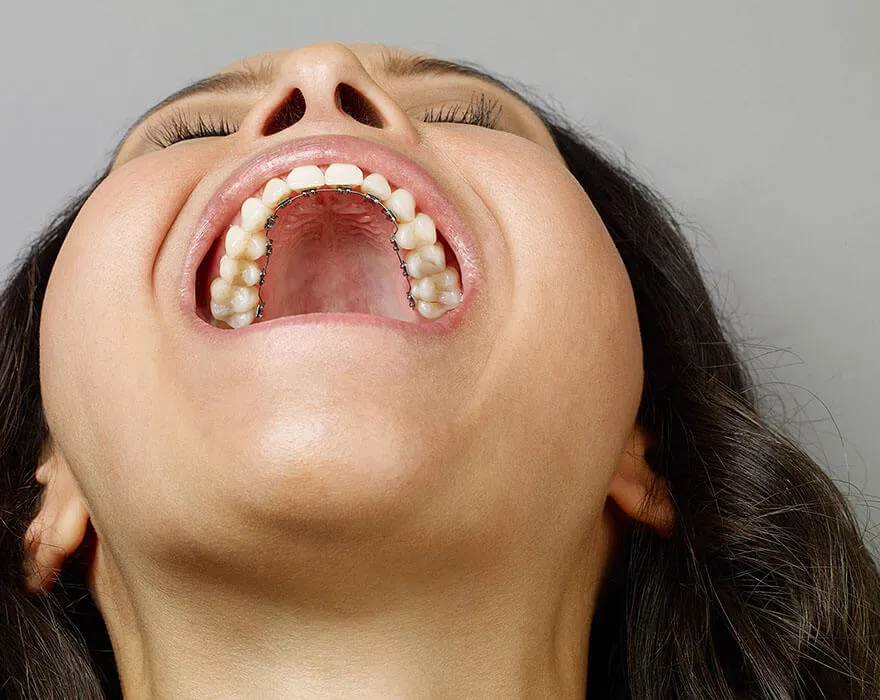
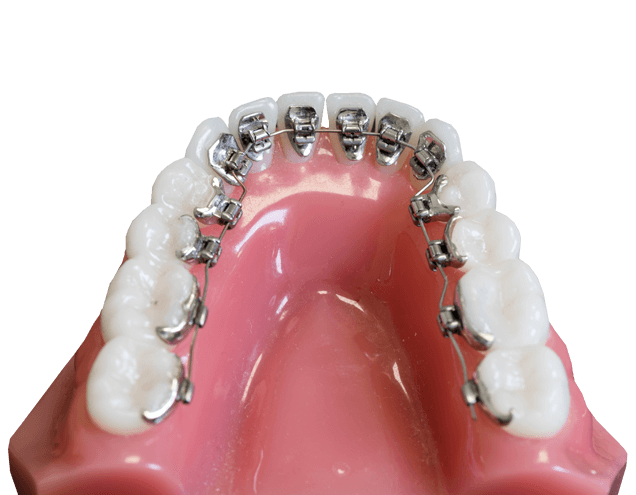
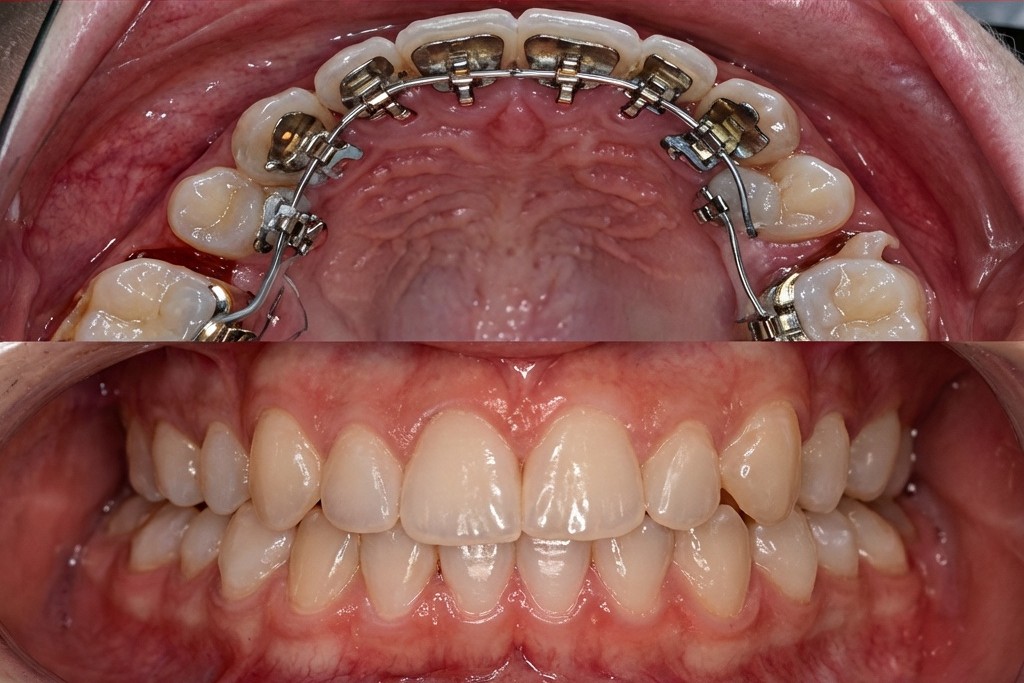
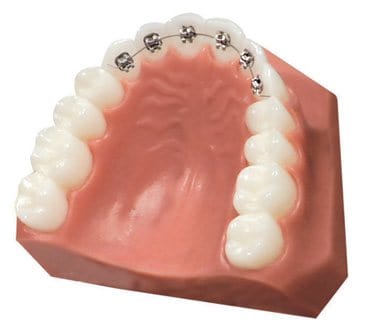
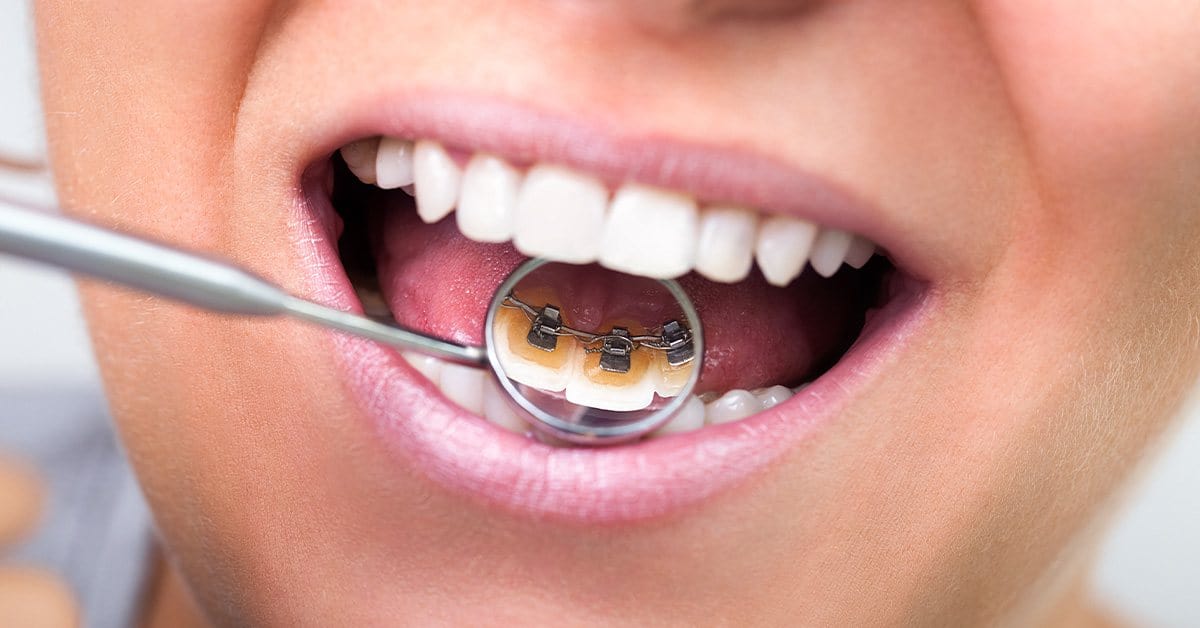
Brackets are placed on the inner surface of the teeth, making the appliance totally invisible from the outside. Even up close, no one will see your braces.
Lingual orthodontics uses the same principle as traditional braces, but with a crucial difference: the brackets are attached to the inner surface of the teeth, on the tongue side.
An orthodontic wire runs through these brackets and applies the forces needed to move your teeth into their ideal position. The result? A complete and effective treatment, without anyone noticing you are wearing an appliance.
This technique requires specialized expertise and advanced training, but offers discretion impossible to match with other methods.
Even up very close, no one can see your braces. Ideal for professionals and image-conscious individuals.
Can correct all cases, including the most complex. No limitations compared to traditional braces.
No risk of white spots or discolouration on the visible surface of the teeth.
Lingual orthodontics is particularly suited for adults and older teens who want to straighten their smile without anyone knowing.
Ideal for:
If aesthetics is an absolute priority for you, lingual orthodontics offers maximum discretion.
Complete consultation to determine if you are a good candidate. Clinical examination and 3D X-rays.
Ultra-precise digital impressions of your teeth to manufacture your custom brackets.
Your brackets are custom-made in a specialized lab. Timeline: 4 to 6 weeks.
Installation of brackets on the inner surface of your teeth. Session of 2 to 3 hours.
Appointments every 6 to 8 weeks to adjust the wire and monitor your progress.
Removal of the appliance and placement of a retainer to maintain your new smile.
Like any orthodontic appliance, lingual braces require an adjustment period. Here is what to expect:
Week 1-2: Slight tongue discomfort and minor speech difficulty. Your tongue needs to get used to the brackets. Most patients regain normal speech within 7 to 14 days.
Week 3+: Adaptation is usually complete. You even forget you are wearing an appliance.
We provide all the tools and advice to ease this transition and minimize discomfort.
The pain is similar to traditional braces: mild tooth sensitivity for 2-3 days after each adjustment. The tongue may be slightly irritated for the first few days, but adapts quickly. Over-the-counter pain relievers are usually sufficient.
Yes, with some precautions. Avoid overly hard foods (nuts, ice) and sticky foods (caramel, gum). For the first few days, stick to soft foods. After the adjustment period, you can eat almost normally.
Duration is similar to traditional braces: 18 to 24 months on average for standard cases. Complex cases may require up to 30 months. Your personalized treatment plan will give you a precise estimate.
Temporarily, yes. In the first few days, you may have a slight lisp or difficulty with certain consonants (S, T, D). Most patients regain normal speech within 7 to 14 days. Practising reading aloud accelerates the adjustment.
Find out if lingual orthodontics is right for you during a free orthodontic consultation.
Board-certified orthodontist with over 20 years of experience, Dr Benguira completed his orthodontic training at the Université de Montréal following a doctorate in dental medicine. A recognized specialist on the North Shore, he combines clinical expertise and cutting-edge technology to deliver outstanding results for every patient.